Ariane 5 Flight 501: Firmware Reuse Safety Lessons
The maiden flight of Ariane 5 lasted 39 seconds.
At T+36.7 seconds, the back-up Inertial Reference System placed a diagnostic bit pattern on the databus and halted its processor. About 50 milliseconds later, the active unit did the same. The On-Board Computer, with no healthy attitude source, treated the diagnostic pattern as flight data and commanded full nozzle deflection.
At T+39 seconds, the launcher disintegrated under aerodynamic load and triggered its own self-destruct. Four Cluster scientific satellites went with it. The direct cost of the failure was approximately $370 million [1]; ESA’s own accounting of the four-satellite rebuild alone came to 351 million accounting units, roughly $351 million in 1996 [2].
Here’s the part that should make every embedded developer uncomfortable. The code that destroyed the rocket had flown without incident on Ariane 4 for over a decade. It wasn’t buggy. It worked. It just stopped being correct the moment the operating envelope changed, and nobody checked.
That gap, the space between “this code works” and “this code is safe to reuse here,” is what firmware reuse safety is really about. As the ESA Inquiry Board report [3] later made clear, the defect was not a bug. It was a design decision that became wrong when operating conditions changed.
In this post, I’ll walk through what actually happened on Flight 501, trace the failure to a single 16-bit conversion, and show you why the same pattern of broken firmware reuse safety is present in reused firmware shipping today and how we can prevent it.
Let’s dig in!

What Happened in 37 Seconds
Start with the architecture, because the failure makes no sense without it.
The Ariane 5 Flight Control System carried two Inertial Reference Systems, or SRIs, running in parallel. Identical hardware. Identical software. One active, one hot stand-by. Each computed the launcher’s attitude from a strap-down platform of laser gyros and accelerometers, and each fed its data to two On-Board Computers (OBCs). The design intent was the textbook one: if the active SRI failed, the OBC would switch to the back-up and the mission would continue [3].
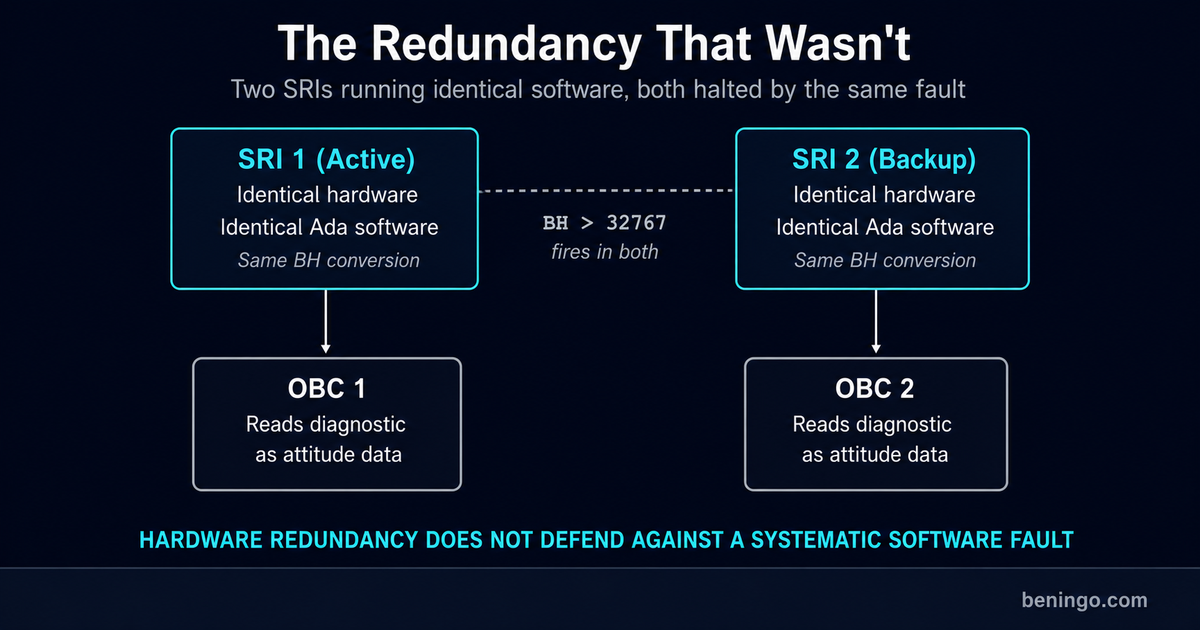
That switchover logic was correct. It was also useless on the day, and the reason why is the whole story.
The failure sequence itself I already walked through in the introduction: both SRIs halted within 50 milliseconds of each other, the OBC read a diagnostic bit pattern as attitude data, and the vehicle commanded a hard correction into a deviation that never existed. What matters here is the mechanism underneath that sequence.
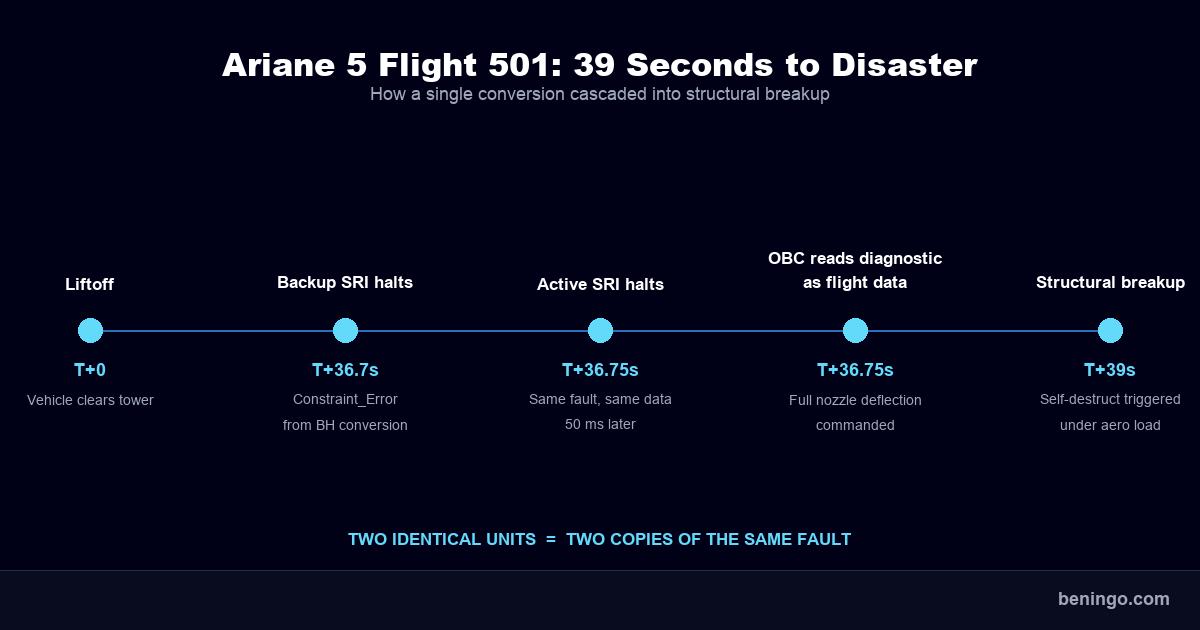
When the active SRI hit its internal exception, it did exactly what its specification demanded. It stopped. It placed a diagnostic bit pattern on the data bus, wrote its failure context to memory, and halted the processor [3]. The OBC was now looking for a healthy unit to switch to. There wasn’t one, because the back-up had already run the same code against the same data and halted the same way. The switchover logic worked perfectly and had nowhere to go.
The diagnostic pattern compounded it. That bit pattern was never intended to be read as flight data. It was a failure indicator, meaningful only to something that was looking for one. But to an OBC starved of any valid attitude source, it was just the bytes on the bus, and the OBC acted on them [3].
We know all of this with certainty because the hardware survived to tell us. Recovery teams pulled both SRI units from the debris field and read out their memory. The readout confirmed the scenario end to end: both units, same fault, same path, milliseconds apart [3]. This surfaces the uncomfortable truth: two identical units running identical software are not redundant against a software fault. They are two reliable copies of the same fault, waiting for the same trigger.
That trigger was a single numeric conversion.
The Technical Root Cause: A 16-Bit Conversion That Could Not Fail
The variable at the center of the disaster was called BH, the horizontal bias. It was an internal value in the SRI’s alignment software, a measure of horizontal velocity sensed by the platform. Inside the SRI, BH was represented as a 64-bit floating-point number. At one point in the alignment code, it was converted to a 16-bit signed integer [3].
A 64-bit float can hold values that a 16-bit signed integer cannot. The integer tops out at 32,767. When the float carries a number larger than that, the conversion has nowhere to put it. The question every embedded developer should be asking at this point is: what happens then?
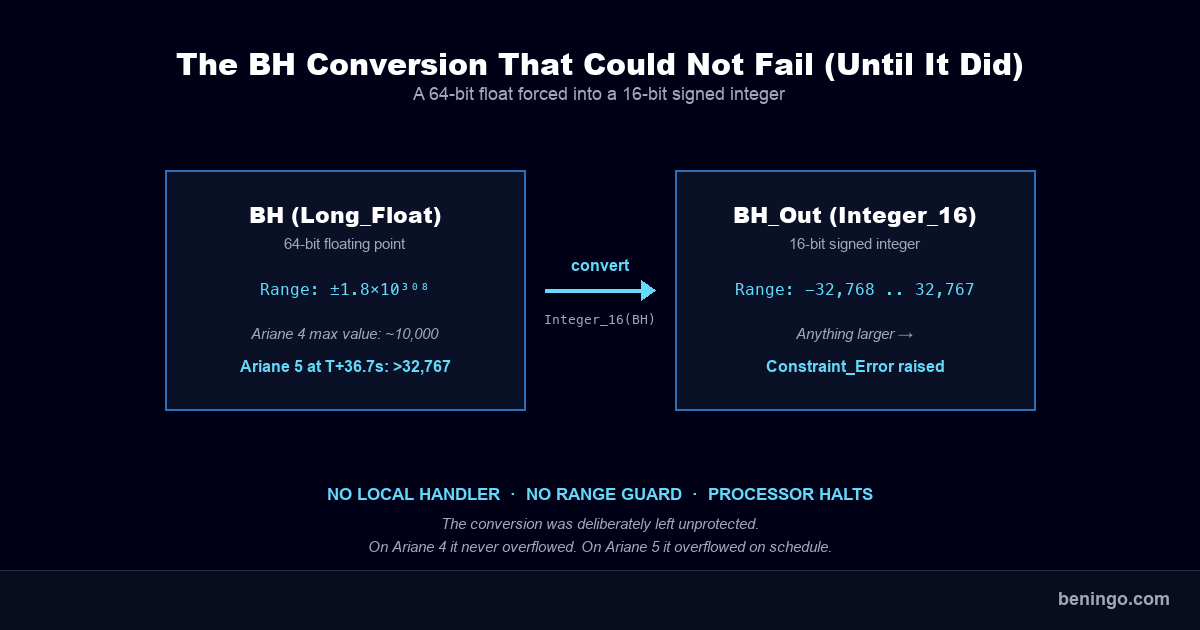
The SRI was written in Ada, and Ada does not look away from this. A conversion from a wider numeric type to a narrower one raises an exception when the source value falls outside the destination range, unless the code either wraps the conversion in a handler or proves the source can never exceed the bound [3]. This is the language doing its job. It refuses to silently truncate. It forces the question. In the Ada 83 dialect the SRI used, that exception was called Operand_Error; a modern Ada compiler raises the equivalent Constraint_Error, which is the name used in the code below.
The conversion that failed did neither. BH grew past 32,767; the conversion raised the exception, and nothing local caught it [3].
From there, the SRI did what its specification told it to do on any unhandled exception: declare a failure, put the diagnostic pattern on the databus, write context to memory, and halt. The specification drew no line between a hardware fault and a software exception. Both routes led to the same processor stop [3]. So, an arithmetic condition in a single conversion was treated as a dead unit, and the dead unit took its identical twin down with it 50 milliseconds later.
Here is the part that separates this from an ordinary bug. The lack of protection on BH was not an oversight. The development team had identified seven float-to-integer conversions at risk of exactly this failure. They protected four of them. They deliberately left three unprotected, BH among them, on the documented reasoning that those values were physically limited or carried a large margin of safety [3].
On Ariane 4, that reasoning was sound. The vehicle’s flight profile kept BH comfortably within the 16-bit range, so the conversion could never overflow; protecting it would have wasted cycles guarding against the impossible. And cycles mattered: the team was working against a hard constraint of 80 percent maximum workload on the SRI computer [3]. Leaving the three conversions unprotected was a defensible engineering trade against a real budget.
Then the code moved to Ariane 5, which builds horizontal velocity roughly five times faster in early flight [3]. The same BH, computed the same way, now climbed past 32,767 about 37 seconds after liftoff. The conversion that could not overflow on Ariane 4 overflowed on schedule on Ariane 5. Nothing in the code changed. The envelope changed, and the code’s hidden assumption changed from true to false without a single line being touched.
This is what Jézéquel and Meyer later framed as a broken contract [4]. The conversion carried an implicit precondition: BH stays within 16-bit range. On Ariane 4 the operating environment satisfied that precondition, so it was never written down and never enforced at the conversion site. On Ariane 5 the environment violated it. The contract was never renegotiated because nobody knew it existed. It had been true for so long that it had stopped looking like an assumption at all.
A representative version of the unprotected conversion might look something like the following:
-- Representative reconstruction. NOT the original SRI source,
-- which is not public. Illustrates the mechanism only.

-- BH ("horizontal bias") is computed in 64-bit float, then
-- converted to a 16-bit signed integer for output.

declare
   type Integer_16 is range -32768 .. 32767;  -- 16-bit signed

   BH     : Long_Float;        -- 64-bit, horizontal bias
   BH_Out : Integer_16;
begin
   -- ... alignment computation sets BH ...

   -- Unprotected narrowing conversion. On Ariane 4, BH was small
   -- enough that this never overflowed. No handler, no range guard.
   BH_Out := Integer_16 (BH);  -- raises Constraint_Error if BH > 32767

   Send_To_Databus (BH_Out);
end;The guarded form that would have contained it might have looked like the following:
-- Representative reconstruction. Illustrates a containment strategy,
-- not the original code.

declare
   type Integer_16 is range -32768 .. 32767;  -- 16-bit signed

   BH     : Long_Float;
   BH_Out : Integer_16;

   BH_Max : constant Long_Float := Long_Float (Integer_16'Last);   -- 32767.0
   BH_Min : constant Long_Float := Long_Float (Integer_16'First);  -- -32768.0
begin
   -- ... alignment computation sets BH ...

   -- Option A: saturate instead of overflowing.
   if BH > BH_Max then
      BH_Out := Integer_16'Last;
      Flag_Saturation;            -- record that the value was clamped
   elsif BH < BH_Min then
      BH_Out := Integer_16'First;
      Flag_Saturation;
   else
      BH_Out := Integer_16 (BH);
   end if;

   Send_To_Databus (BH_Out);
exception
   -- Option B: a local handler so an out-of-range value degrades the
   -- output instead of halting the processor. Best-effort, not shutdown.
   when Constraint_Error =>
      BH_Out := Integer_16'Last;  -- or a defined "data invalid" sentinel
      Flag_Best_Effort_Output;
end;Note: The code was written in Ada 83 and is not public. I’ve done my best to write what I think would be representative of the original code, but it’s just an illustration.
The fix, in hindsight, was small. A range check at the conversion site. A handler that clamped or flagged instead of halting the processor. A few lines. But the real failure was never in those few lines. Those were just a symptom.
The real failure was in the assumption that code which had run flawlessly for a decade had earned the right to run unexamined on a new vehicle. That assumption is the heart of every firmware reuse safety conversation worth having.
How a 1989 Requirement Reached 1996
By now the obvious question is nagging: why was code that computed horizontal bias even running 37 seconds into the flight? The launcher was long gone from the pad. Alignment was finished. What was that software still doing?
The answer is the part of this story that should worry you most, because it has nothing to do with Ada or integers and everything to do with how reused code carries its history forward. It is also the part of firmware reuse safety that almost nobody audits for.
The alignment function existed to solve an Ariane 4 problem. On Ariane 4, if the countdown went into a hold late in the sequence, restarting the inertial platform’s alignment took 45 minutes. That was unacceptable for a narrow launch window. So the engineers built a feature: keep the alignment software running for a few seconds after the predicted liftoff moment, so that a late hold could be recovered without starting the 45-minute clock over [3]. It was a sensible solution to a real operational constraint.
That feature was used exactly once, on Ariane 4 Flight 33, in 1989 [3]. After that it sat in the codebase, doing nothing, harming nothing.
When the SRI software was carried over to Ariane 5, the feature came with it. Not because anyone needed it. Ariane 5 had a different countdown sequence, and the late-hold recovery scenario it was built for did not apply [3]. The feature was retained for commonality, the entirely reasonable-sounding instinct that says: don’t modify working flight software you don’t have to touch. Changing it would mean re-testing it. Leaving it in felt safer than taking it out.
So the alignment code ran on for roughly 40 seconds after liftoff on Ariane 5, computing values that meant nothing, serving no purpose in the mission, right up until BH crossed 32,767 and the whole vehicle paid for it [3]. The function that destroyed Ariane 5 was not just reused code. It was reused code that had no reason to be executing at all. (For more on what the broader cost of carrying unexamined legacy code looks like, see legacy code is more expensive than you think.)
That alone would be a clean lesson. But the inquiry found the gap ran deeper than one stale feature.
The SRI’s specification did not include Ariane 5’s trajectory data [3]. The requirements that the alignment software was validated against described an Ariane 4 world. Nobody fed the new vehicle’s flight profile, the one that drives BH five times faster, back into the document that governed the code. The specification and the reality it was supposed to describe had quietly diverged.
It gets worse. In 1992, a decision was made to leave the SRIs out of a key closed-loop system simulation [3]. There were stated reasons: concerns about precision, a mismatch in the simulation’s base period, the difficulty of modeling the SRI’s failure modes. Each was plausible on its own at the time. The consequence was that the one test that fed realistic trajectory data through the actual SRI behavior, the test that would have driven BH past its limit on the ground, was never run. And the 1992 decision was never revisited when Ariane 5 changed the trajectory [3].
None of this was caught in review. That is not an incidental detail. The inquiry board stated plainly that the review process was itself a contributory factor in the failure [3]. The decision to leave the three conversions unprotected, BH among them, was not a quiet mistake buried in one engineer’s code. It was taken jointly by project partners at several contractual levels [3], documented in places that the reviews did not effectively reach.
Step back and look at the shape of it. A feature built for one vehicle, used once, kept out of habit. A specification that described the old world. A simulation that was narrowed for defensible reasons and never widened again. A review process that looked at all of it and saw nothing wrong. Not one of these was a coding error. Every one of them was a decision that made sense in its moment and was never re-examined when the moment changed. The overflow was just the place where all of it finally came due.
What Firmware Reuse Safety Actually Demands
Strip away the rocket, the Ada, and the 1996 timeframe, and Flight 501 leaves three firmware reuse safety patterns that you need to be concerned about that could be happening right now in your own code that’s shipping.
Reused software is only as safe as the operating envelope it was validated against
This is the heart of firmware reuse safety, and it is the one most teams get wrong. Reuse feels like a safe move precisely because the code already works. But “it works” is shorthand for “it worked, once, in one place, against one set of inputs.”
Carrying that code into a new product changes the inputs, and every implicit assumption the code made about its old environment is now an open question. The BH conversion didn’t fail because it was bad code. It failed because a numeric bound that was always true on Ariane 4 became false on Ariane 5, and nobody re-derived it. Reuse is not “same code, same behavior.” Reuse is a new validation problem that happens to share a source file with an old one.
A backup running identical software is not redundancy
We saw this in the wreckage: both SRIs failed on the same code, against the same data, 50 milliseconds apart. Hardware redundancy protects against hardware faults, a dead processor, or a failed sensor. It does nothing to address a systematic software fault because the fault is present in both copies.
An exception handler that halts the processor on a detected anomaly is a reasonable design only when the backup is meaningfully independent: different software, different inputs, or both. Two identical units don’t give you a second chance. They give you the same failure twice, on schedule.
Code that has no purpose in the new mission is not free
The alignment function served no role in Ariane 5 flight, yet it ran for 40 seconds and triggered the loss. Dead code that still executes is not dead. It is live code you have stopped thinking about, which is worse than live code you watch, because it carries all the risk and gets none of the scrutiny. Retaining it “for commonality” feels conservative. It is the opposite. Every line that runs is a line that can fail, whether or not you believe it matters.
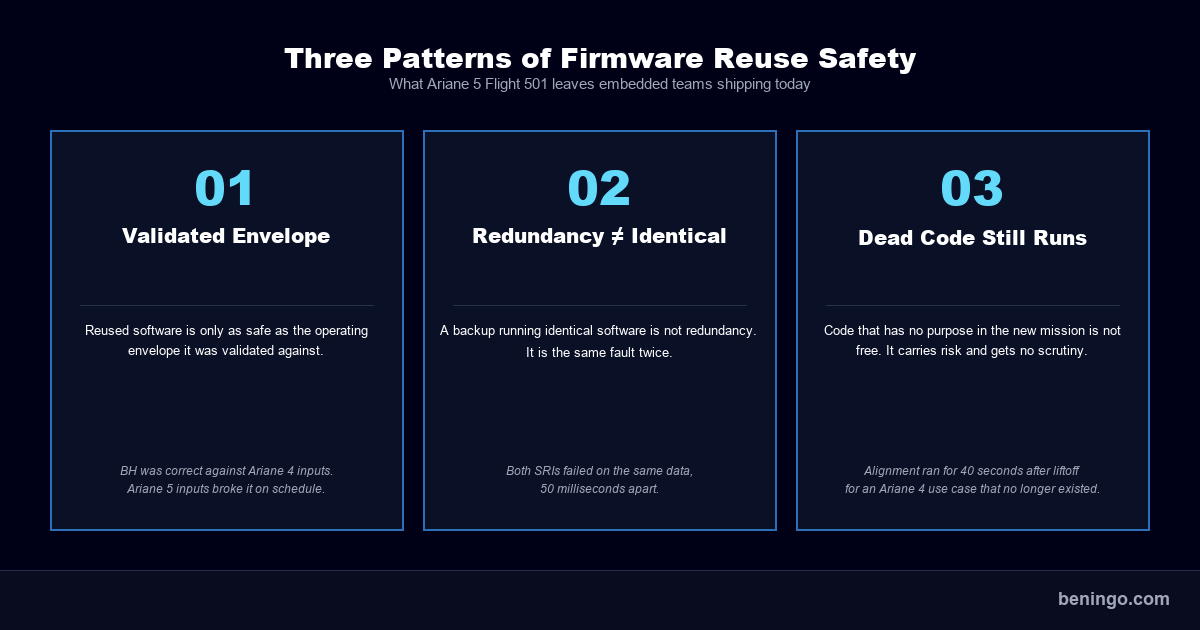
Those three firmware reuse safety patterns are worth keeping somewhere you’ll see them at the next design review. But notice what they share. None of them is about Ada. None is about integers, or rockets, or 1996. Each one is about a single gap: the distance between what code was validated for and where it actually ends up running.
That gap is the whole subject. It doesn’t announce itself, and it doesn’t care how long the code has behaved. It opens the moment a working module crosses into an envelope no one re-checked, and it stays invisible until something downstream forces the issue. On Flight 501 the issue was forced 37 seconds after liftoff. The more useful question is where that same gap is hiding in systems that haven’t launched yet, which is exactly where this stops being a 1996 story.
Where Would Firmware Reuse Safety Fail Today?
Flight 501 reads like a period piece: laser gyros, Ada 83, a launch from 1996. The temptation is to file it under aerospace history and move on. That would be a mistake, because the exact failure shape, working code carried into an envelope it was never validated against, is one of the most common ways embedded software fails today. The hardware changes. The firmware reuse safety pattern doesn’t.
Start with the most direct modern equivalent: automotive ECU reuse across vehicle platforms. A motor controller is validated on a platform with a 250-ampere peak current. It works, ships, and runs for years without complaint. Then it’s reused on a new platform rated at 400 amperes because the control logic is identical, and revalidating it takes time nobody has.
Somewhere inside, a current-bias variable was sized for the original envelope. On the new platform it saturates, and the failure looks exactly like BH: code that was correct against one set of physical limits, silently wrong against another. The same story repeats in brake controllers ported between vehicle masses, transmission controllers across gearbox torque ranges, and steering assist across different rack geometries.
Battery management firmware is a particularly sharp case, because the envelope shift is chemical rather than electrical. A state-of-charge integrator tuned for one cell chemistry assumes a voltage curve, a temperature response, and a charge-acceptance profile. Move that firmware to a pack with a different chemistry, and those assumptions don’t transfer. The integrator can drift or saturate against a curve it was never designed to track, and the symptom, a charge controller acting on numbers that no longer mean what the code thinks they mean, is the BH problem wearing a different hat.
The pattern generalizes anywhere code crosses an envelope boundary: drone autopilots ported between airframes with different launch dynamics, industrial servo drives moved between machines with different acceleration profiles, and medical device platforms carried across patient populations. In each case, the code is trusted because it worked elsewhere. That trust is the firmware reuse safety vulnerability.
Then there is the 2026 version of the problem, the one that should have your attention. AI-assisted development has made it trivial to generate code that looks correct and passes the examples in front of it. An AI coding assistant suggests a conversion, a scaling routine, a filter implementation, compiles it, passes the test cases, and reviews it clean. But “passes the examples it was shown” is not “validated against the envelope it will run in.” That is precisely the Ariane 5 gap, generated faster and in greater volume than any human team could produce. The model that suggested the code has no knowledge of your production current limits, your real trajectory, or your actual cell chemistry. It optimizes for plausible code that has never met its true operating envelope, which is exactly the kind of code that sits quietly for years and then comes due. The firmware reuse safety defect class is not a relic. We are manufacturing fresh instances of it every day with better tooling.
The lineage even runs straight back to where it started. Spacecraft guidance, navigation, and control code is still reused mission to mission, across vehicles with different mass properties and different flight profiles, under the same commonality pressure that kept the alignment function in the Ariane 5 SRI. The envelope keeps changing. The temptation to trust code that already works never goes away.
How to Build Firmware Reuse Safety Into Your Process
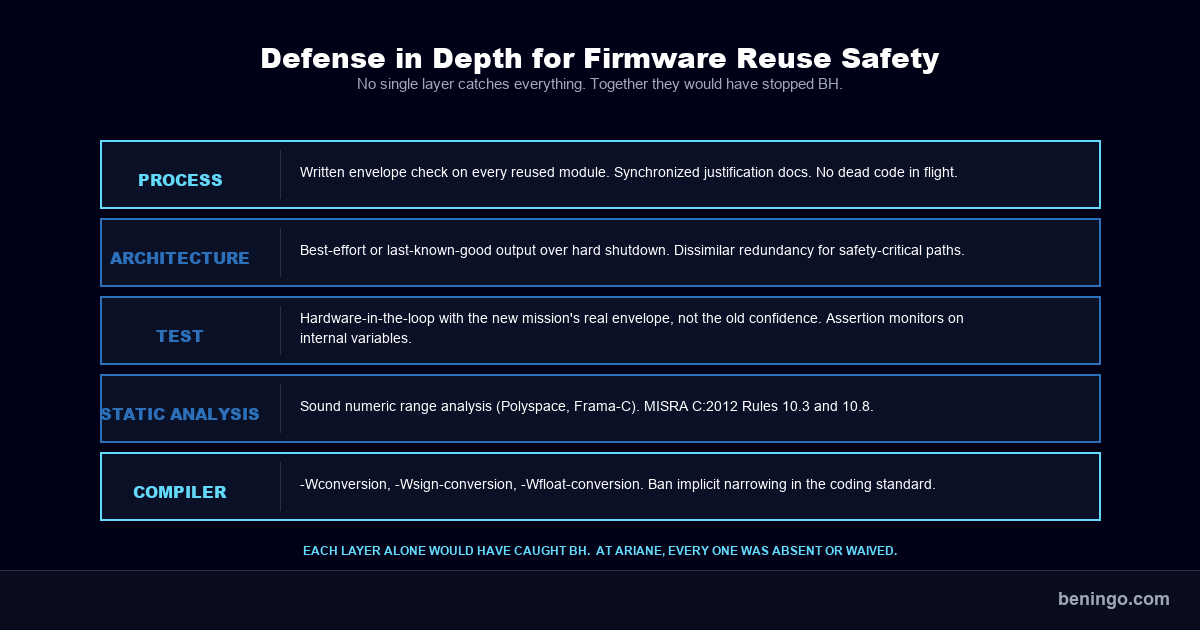
Knowing the pattern is not the same as defending against it. The good news is that the firmware reuse safety defenses are concrete, and none of them requires a research project. Each item below is something a team can implement within a single sprint. They stack in layers, from the compiler up through the process, because no single one of them would have caught BH on its own.
Start at the compiler, because it is the cheapest layer
Implicit narrowing conversions are the exact defect class that destroyed Ariane 5, and modern toolchains will flag them for free. In GCC or Clang, turn on -Wconversion, -Wsign-conversion, and -Wfloat-conversion, and treat the warnings as errors in CI. Then ban implicit narrowing in your coding standard so the rule outlives any one engineer. In Ada, the equivalent discipline is range-constrained subtypes enforced at the conversion site; in C, bounded conversion helpers that check before they cast. The cost is a build-flag change and a few hours fixing what it surfaces.
Add static analysis that reasons about ranges, not just style
A linter that checks formatting would not have saved Flight 501. Sound numeric range analysis would have. For safety-relevant code, MISRA C:2012 Rules 10.3 and 10.8 directly address assignment and casting between types of different size and signedness. Beyond rule-checking, tools like Polyspace Code Prover or Frama-C with the EVA plugin perform sound range analysis: they prove whether a variable can exceed its target range across all reachable inputs.
Run that analysis on every reused module against the new application’s input ranges, not the old ones. The whole firmware reuse safety failure on Ariane 5 was an old validation surviving an input change it never saw. (For more on choosing and qualifying the tools that do this work, see toolchain validation for functional safety.)
Test against the new envelope, not the old confidence
The single test that would have caught BH, feeding realistic Ariane 5 trajectory data through the actual SRI behavior, was the one deliberately left out of the simulation. The lesson is direct: run hardware-in-the-loop and closed-loop simulation with the new mission’s real operating profile, not the profile the code was originally validated against. Put assertion-based monitors on internal variables during those runs, so that an intermediate value crossing its range trips an alarm on the bench rather than in the field. If a module is reused, its test campaign is not inherited. It is re-earned against the new inputs.
Design the architecture so that a detected fault degrades rather than detonates
The SRI’s specification halted the processor on any exception, which is defensible in isolation and catastrophic when the backup runs identical software. Two architectural changes address this.
First, prefer best-effort or last-known-good output over hard shutdown in a sensor unit, so a single out-of-range value does not remove the whole signal, which is the substance of the inquiry’s own recommendation.
Second, if a redundant path is safety-critical, make it genuinely dissimilar: different software, different processor, or both, so a systematic fault cannot take both channels at once. And handle exceptions locally, at the conversion site, where the code knows what a sensible fallback is, rather than punting to a system-level handler that only knows how to stop.
Close the loop at the process layer, because that is where Ariane 5 actually failed
The board was explicit that the review process itself was a contributing factor. Three process habits would have broken the firmware reuse safety chain.
First, require a written operational-envelope check for every reused module: name the input ranges the original validation covered, name the ranges the new application imposes, and justify every difference instead of assuming it away.
Second, keep justification documents synchronized with the code, so the reasoning behind an unprotected conversion is visible to the people reviewing it rather than buried where the reviews can’t reach.
Third, adopt the inquiry’s blunt rule about dead code: no software function should run during flight unless it is needed. If a feature has no purpose in the new mission, disable it. Commonality is not a reason to execute code that cannot help you and can hurt you.
Notice that none of these would have needed all the others. The compiler flag alone would have surfaced BH. The range analysis alone would have caught it. The envelope check alone would have forced the question. The reason Flight 501 happened is that every layer was either absent or waived, and the defect fell straight through. Defense in depth works precisely because it does not depend on any single layer being perfect.
The Contract No One Renegotiated
Ariane 5 Flight 501 is remembered as a software failure, but that framing lets too many people off the hook. The code did what it was written to do. The conversion that overflowed had been correct for over a decade. What failed was the assumption that correctness travels with the code, that a module which worked on one vehicle had earned the right to run unexamined on the next. It hadn’t. BH was not a bug. It was a firmware reuse safety contract that no one had renegotiated in twelve years, and the renewal notice arrived 37 seconds after liftoff.
The reason this matters to you, specifically, is that almost no embedded team writes everything from scratch. You inherit drivers. You port control loops. You carry a sensor stack from the last product into the next one because it works and the schedule is tight. Every one of those moves is a reuse decision, and every reuse decision is a quiet bet that the old envelope still holds. Most of the time it does. The Ariane 5 lesson is about the time it doesn’t, and about making that bet explicit instead of invisible.
If you take three firmware reuse safety takeaways from this case into your own work, make them these:
- Treat every reused module as new code under a new contract. Before it ships in the new product, write down the input ranges its original validation covered and the ranges the new application imposes. Where they differ, justify the difference or re-validate. Do not let “it already works” stand in for that check.
- Turn on the cheap defenses today. Enable
-Wconversion,-Wsign-conversion, and-Wfloat-conversion, treat them as errors in CI, and ban implicit narrowing in your coding standard. This is an afternoon of work that closes the exact hole BH fell through. - Disable code that has no job in the current mission. If a feature does not serve the product you are shipping, it should not be executing in the product you are shipping. Commonality is not a reason to run code that can only hurt you.
The harder question is the one the inquiry could only answer in hindsight, and the one you can still answer in time. Somewhere in your codebase is a module reused from a product that retired years ago, trusted precisely because it has never given anyone a reason to look at it. The envelope it was validated against may not be the envelope it runs in today. Flight 501 is what it looks like when nobody checks. The firmware reuse safety work is to check before the renewal notice arrives on its own schedule.
References
- Dowson, M. “The Ariane 5 Software Failure.” ACM SIGSOFT Software Engineering Notes, 22(2), March 1997, p. 84.
- Credland, J. “The Resurrection of the Cluster Scientific Mission.” ESA Bulletin, No. 91, August 1997.
- Lions, J. L., et al. ARIANE 5 Flight 501 Failure: Report by the Inquiry Board. European Space Agency, 19 July 1996.
- Jézéquel, J.-M., and Meyer, B. “Design by Contract: The Lessons of Ariane.” IEEE Computer, Vol. 30, No. 1, January 1997, pp. 129-130.
Want embedded engineering insights like this delivered to your inbox? Sign up for my Embedded Bytes newsletter to get the latest posts, insights, and hands-on tips delivered straight to your inbox.
Struggling to keep your development skills up to date or facing outdated processes that slow down your team, raise costs, and impact product quality?
Here are 4 ways I can help you:
- Embedded Software Academy: Enhance your skills, streamline your processes, and elevate your architecture. Join my academy for on-demand, hands-on workshops and cutting-edge development resources designed to transform your career and keep you ahead of the curve.
- Consulting Services: Get personalized, expert guidance to streamline your development processes, boost efficiency, and achieve your project goals faster. Partner with us to unlock your team's full potential and drive innovation, ensuring your projects success.
- Team Training and Development: Empower your team with the latest best practices in embedded software. Our expert-led training sessions will equip your team with the skills and knowledge to excel, innovate, and drive your projects to success.
- Customized Design Solutions: Get design and development assistance to enhance efficiency, ensure robust testing, and streamline your development pipeline, driving your projects success.
Take action today to upgrade your skills, optimize your team, and achieve success.