
3 Strategies for Developing a Successful Firmware Architecture
When most people picture software architecture (or a firmware architecture), they imagine clean state machines, tidy flowcharts, and elegant sequence diagrams.
The brutal truth?
Most firmware architectures end up as a giant tangled ball of mud.
They’re brittle. They’re tightly coupled. They blur hardware and application logic together. Instead of enabling growth and reuse, they trap teams in endless cycles of:
- Bug chasing
- Mounting technical debt
- Slipping schedules
- Bloated budgets
It doesn’t have to be this way.
A well-structured architecture isn’t just an academic exercise; it’s the foundation that determines whether your team can deliver on time, scale features, and keep maintenance costs under control. Done right, it reduces the human effort needed to build and sustain the system, freeing developers to focus on innovation rather than firefighting.
In this post, I’ll share three strategies I use with clients (and in my own projects) to design firmware architectures that last, which make testing easier, reduce coupling to hardware, and stand the test of time.
What is a Software Architecture?
One of my favorite definitions for software architecture is the deprecated IEEE 1471 definition, which states:
“A software architecture is the fundamental organization of a system embodied in its components, their relationship to each other and the environment, and the principles guiding its design and evolution.”
This simple statement has a lot for us to unwrap.
First, software architecture is about how you organize the components of your system. What is a component? While we have a specific definition of components when we think about code, architecturally, a component could be:
- Tasks
- Processes
- Layers
- Components (think class diagrams)
- Containers
What you call a component will depend on where you are in your architecture. For example, at the highest level of the architecture, you may be working with containers or processes, which are then broken down into tasks and finally components.
Don’t get too attached though to any specific definition of software architecture. Many architectures refuse to define software architecture because the definition is always changing.
Ralph Johnson defines software architecture as:
“The decisions you wish you could get right early in a project.”
Software architecture today will often dictate how you organize firmware and whether modern techniques like unit testing, simulation, and CI/CD will be easy to leverage or nearly impossible!
While there are many definitions for software architecture, there is one uncomfortable truth: A good software architecture aims to minimize the human resources required to build and maintain the system!
These resources include:
- Number of developers
- Time to market
- Cost to market
- Maintenance costs
- Technical debt
So, how do we achieve a software architecture for firmware? Let’s dig in and discuss several strategies I’ve found to be effective with my clients and in my projects.
Note: Here are some additional ideas to Transform Your Embedded Software Architecture with These Powerful Practices
Firmware Architecture Strategy #1 – Data Dictates Design
The success of any embedded systems project requires the development team to break down the system into smaller and more manageable pieces. While many different strategies can help teams achieve this goal, the one I’ve found to be the most productive is allowing data to dictate the design.
Data is at the heart of every software system. That data might be the state of a push button or the events driving a state machine.
Sometimes, firmware engineers find it challenging to view their system as data because we weren’t taught to think that way in school! Many of us didn’t start as software engineers but in some other discipline of engineering, like electrical engineering.
Thinking about your system as data can seem strange at first, but here are some simple questions you can ask yourself to identify the data:
- What data is input to my system?
- How is data transformed?
- How is data transferred?
- How is data stored?
- How is data output?
You can literally think about this from a data flow perspective! Below is a diagram where I trace the data that is generated by a pushbutton to determine if an LED should be turned on:
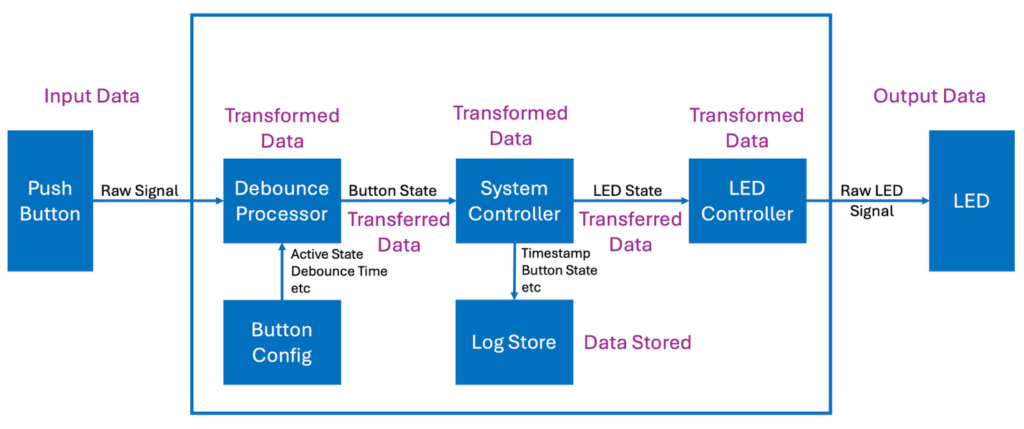
I started by tracing the data produced by the push button (data input). Once I understood what data is input, I can ask the next question which led to transforming the raw data into debounced button state data (transformed data). That led the transformed data being transferred to something else that uses that data (transferred data).
Something then needs to use that transformed button data to do work. So the data is once again transformed from push button data to what the state of an LED should be. That data is transferred then in two places; one to a log store (data store) and then to something that converts the LED state to an output the hardware can use to control the LED.
At first, I may not know what’s in those blue boxes, but from following the data through the system, I start to understand what’s happening to the data, which then dictates what components, services and other architectural components I’ll need!
Firmware Architecture Strategy #2 – There is no hardware, only data
If there is any strategy that makes a firmware engineer rebel, it’s this one. As embedded engineers, we’re used to working at low levels of software. Working directly with hardware registers, optimizing performance, and understanding the inner workings of the hardware.
Here’s the bad news.
A great firmware architecture doesn’t care!
In fact, a great firmware architecture abstracts away all those low-level details. It separates the application from the hardware! All that special sauce that we firmware folks like to spend our days focusing on isn’t important!
I’m not saying that what happens at the hardware level isn’t important, because it is. I’m saying that you need to decouple those low-level features from the application so that you can leverage modern design techniques like CI/CD, unit testing, simulation, and more.
Yes, there are a lot of applications where what the hardware does and how you interact with it is critical. However, if you’re designing software that has to be used in multiple products for the next 5 – 10 years, there is no hardware, only data!
You must decouple the hardware from the application. That means you look at the hardware not as something physical but as something that generates and consumes data.
For example, you application doesn’t care what type of physical button is connected to your system or that it has a 100 ms debounce time and is active high. The application cares about whether the button is pressed or not pressed. So, we design our architecture to not worry about directly reading a GPIO line, but instead to get the result of that read as data and then process that.
The result is application code that is scalable, reusable, and flexible. Did I mention it also makes it hardware independent?
Now, you might throw a fit and say that you can’t do that in embedded. We’re special. We need the application to interact directly with the hardware. In some cases, you might be right. But I’ve worked on over 200 projects, and you know what I’ve learned?
In most cases, our microcontrollers are fast enough, our compilers are good enough, and our abstractions are efficient enough to architect our firmware using modern techniques and still deliver a system that performs as expected.
So when you’re tempted to couple your application tightly to the hardware, don’t! There is no hardware, only data!
Firmware Architecture Strategy #3 – Design from the Top Down
One of the biggest mistakes I see in firmware projects is starting from the bottom: writing drivers, fiddling with registers, or hacking together hardware bring-up code before anyone has a clear picture of the system. The result? Teams build themselves into a corner with an architecture that reflects short-term needs rather than long-term goals.
A successful architecture starts at the top. You don’t begin with the peripherals! You begin with the system. What problem are you solving? What are the major responsibilities of your software? How should data flow from one layer to another?

By designing top-down, you:
- Define the system’s big picture before coding a single driver.
- Break the architecture into layers, services, and components that align with responsibilities rather than hardware quirks.
- Ensure that critical cross-cutting concerns like testability, logging, error handling, and security are part of the architecture from day one, not bolted on later.
- Create a framework where bottom-up details (drivers, interrupts, HAL code) can be slotted in after the structure is in place.
When you design from the top down, you create clarity for the team. Everyone knows where new code belongs, how components interact, and what boundaries should never be crossed. The result is an architecture that grows gracefully, instead of collapsing under the weight of short-term hacks.
The Bottom Line
Firmware architecture isn’t about elegance on a whiteboard; it’s about building systems your team can deliver, sustain, and evolve without drowning in technical debt.
How do you do that?
By letting data dictate your design, treating hardware as just another data source, and designing from the top down.
By following these strategies, you create scalable, testable, and resilient architectures. The payoff is real: fewer bugs, faster schedules, lower costs, and more freedom to innovate.
Invest in your architecture up front, and you’ll spend the rest of the project reaping the rewards instead of firefighting.
Need additional guidance to help you develop a lasting firmware architecture?
Here are a few options to go deeper:
- Attend my on-demand Embedded Software Architecture Masterclass
- Get feedback on your design by contacting me at [email protected]
- Get help architecting your embedded system by contacting me at [email protected]
Struggling to keep your development skills up to date or facing outdated processes that slow down your team, raise costs, and impact product quality?
Here are 4 ways I can help you:
- Embedded Software Academy: Enhance your skills, streamline your processes, and elevate your architecture. Join my academy for on-demand, hands-on workshops and cutting-edge development resources designed to transform your career and keep you ahead of the curve.
- Consulting Services: Get personalized, expert guidance to streamline your development processes, boost efficiency, and achieve your project goals faster. Partner with us to unlock your team's full potential and drive innovation, ensuring your projects success.
- Team Training and Development: Empower your team with the latest best practices in embedded software. Our expert-led training sessions will equip your team with the skills and knowledge to excel, innovate, and drive your projects to success.
- Customized Design Solutions: Get design and development assistance to enhance efficiency, ensure robust testing, and streamline your development pipeline, driving your projects success.
Take action today to upgrade your skills, optimize your team, and achieve success.