
Embedded Engineer Cost: The Hidden $580K Tax
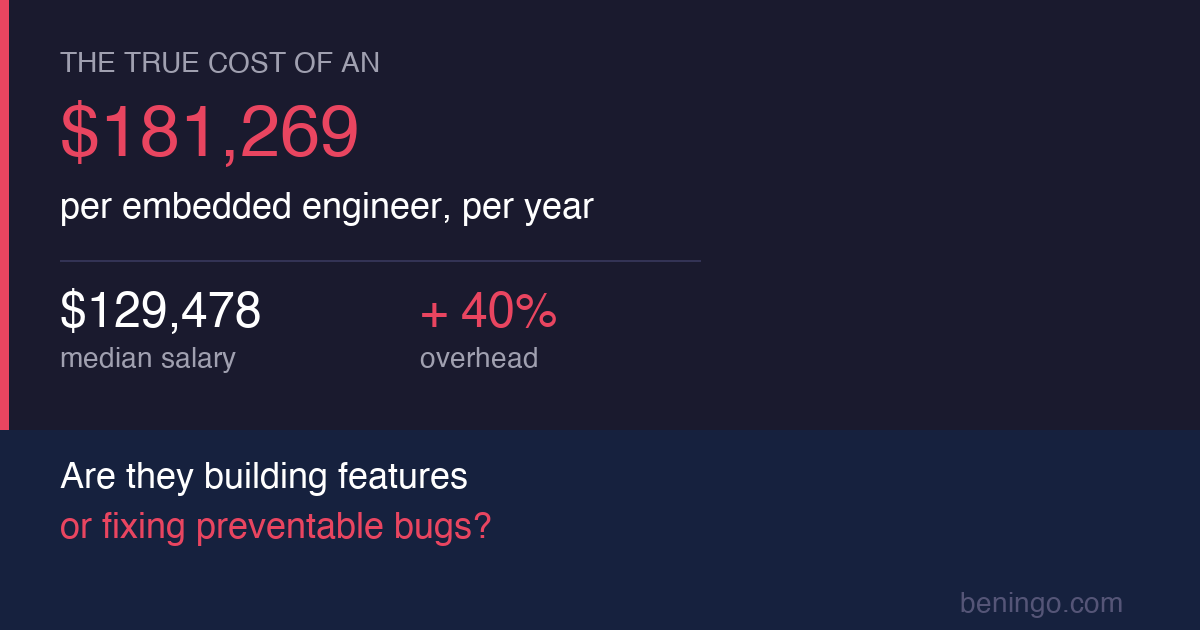
Each embedded engineer costs your company $181,269 per year. That’s the fully loaded embedded engineer cost once you account for salary, benefits, tools, and overhead. The question every engineering leader should ask is simple: are those engineers building features, or are they fixing preventable bugs?
Most teams don’t know the answer because the costs hide in plain sight.
In this post, we’ll break down the fully loaded embedded engineer cost, show where most of that money actually goes, and walk through a simple formula to calculate your team’s annual debugging tax. We’ll also look at what happens when you invest in reducing that tax — and why the payback period is shorter than most leaders expect.
The Real Embedded Engineer Cost Breakdown
According to industry data, the median embedded software engineer salary in the United States is approximately $129,478 per year. However, salary alone doesn’t reflect what an engineer actually costs your organization.
To calculate the true cost, you need to add roughly 40% for overhead. This includes:
- Health insurance and benefits
- Development tools and software licenses
- Facilities, equipment, and lab hardware
- Management overhead and HR costs
- Training and professional development
That brings the fully loaded cost to approximately $181,269 per engineer per year:
| Component | Amount |
|---|---|
| Median base salary | $129,478 |
| Benefits, insurance | ~$19,400 |
| Tools, licenses, equipment | ~$12,900 |
| Facilities and lab hardware | ~$10,400 |
| Management and HR overhead | ~$9,091 |
| Fully loaded cost per engineer | $181,269 |
For an 8-person embedded team, that totals $1.45 million annually. Understanding this number is the first step toward making smarter investment decisions about how your team spends its time.
Where the Embedded Engineer Cost Actually Goes
Now comes the strategic question: what’s the return on that $1.45 million investment?
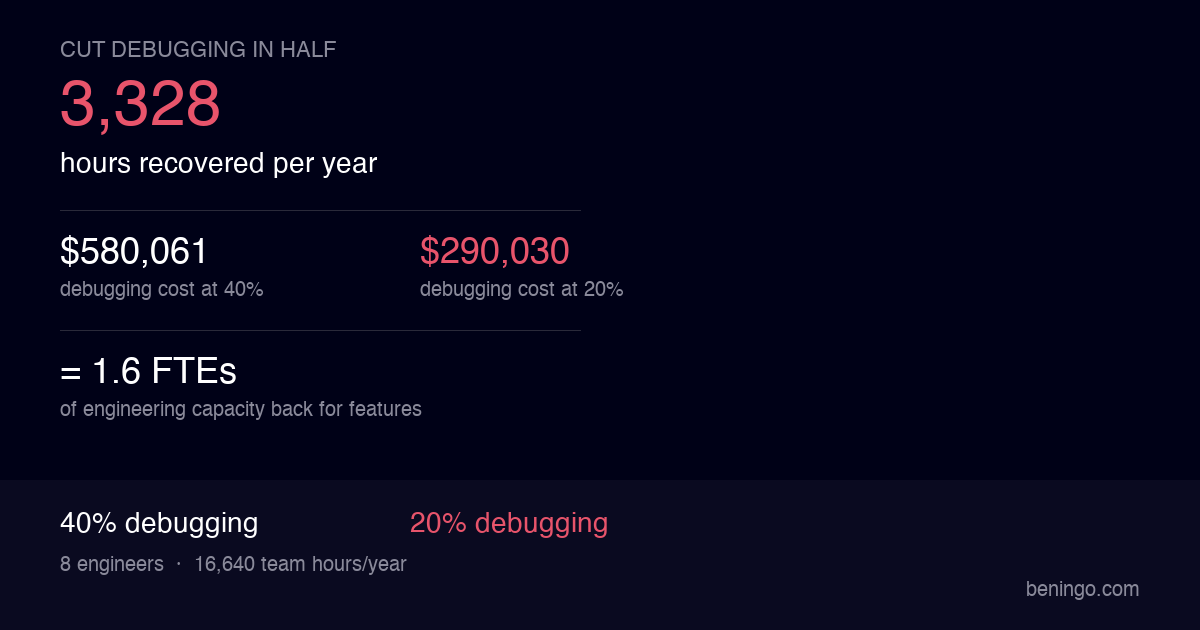
In many embedded teams, a significant portion of engineering time goes to debugging rather than building new features. Industry estimates suggest that 40% or more of development time can be consumed by finding and fixing preventable defects. For an 8-person team, that translates to roughly $580,000 per year spent on rework instead of delivering value.
The reason most leaders don’t see this problem is straightforward: debugging looks like “development” on the timesheets. There’s no line item for “time spent chasing a bug that proper testing would have caught.” As a result, the true cost of rework stays invisible until someone does the math.
According to the NIST Planning Report 02-3, software defects found during integration testing cost 10–15 times more to fix than defects caught during unit testing. In embedded systems, hardware-software integration adds another layer of complexity, and those costs compound even further.
I see the same pattern repeatedly across embedded teams, and it’s one of the reasons legacy code and fragmented toolchains end up costing far more than teams realize.
Calculate Your Team’s Debugging Tax
Here’s a simple exercise you can do right now to estimate how much your team spends on preventable rework:
- Take your team size. Count every embedded engineer, including contractors.
- Multiply by $181,269 (or use your own fully loaded embedded engineer cost if you’ve calculated it).
- Estimate your debugging percentage. Be honest. Include time spent on integration issues, regression bugs, hardware-software mismatches, and “it works on my board” problems.
- Multiply. That’s your annual debugging tax.
Here’s what the debugging tax looks like at different team sizes:
| Team Size | Fully Loaded Cost | Debugging at 25% | Debugging at 40% |
|---|---|---|---|
| 4 engineers | $725,076 | $181,269 | $290,030 |
| 8 engineers | $1,450,152 | $362,538 | $580,061 |
| 12 engineers | $2,175,228 | $543,807 | $870,091 |
| 16 engineers | $2,900,304 | $725,076 | $1,160,122 |
Even a conservative 25% estimate means a typical 8-person team spends over $362,000 per year on rework. At 40%, that number jumps to $580,000.
The Investment That Pays for Itself
Once you know your debugging tax, a different question emerges: what if you could cut it in half?
Consider investing $200,000 in modernizing your development practices. This might include:
- Better software architecture — Modular designs with hardware abstraction layers (see Embedded Software Design for a complete framework) that isolate hardware dependencies and make code testable
- Testing infrastructure — Unit testing frameworks, CI/CD pipelines, and test-driven development practices adapted for embedded teams
- Better developer tooling — A free tool like AstroGrep for code search cuts time engineers spend hunting through legacy code — directly reducing the debugging tax.
- Embedded AI tools — AI-assisted code review, static analysis, and automated test generation that catch defects before they reach hardware
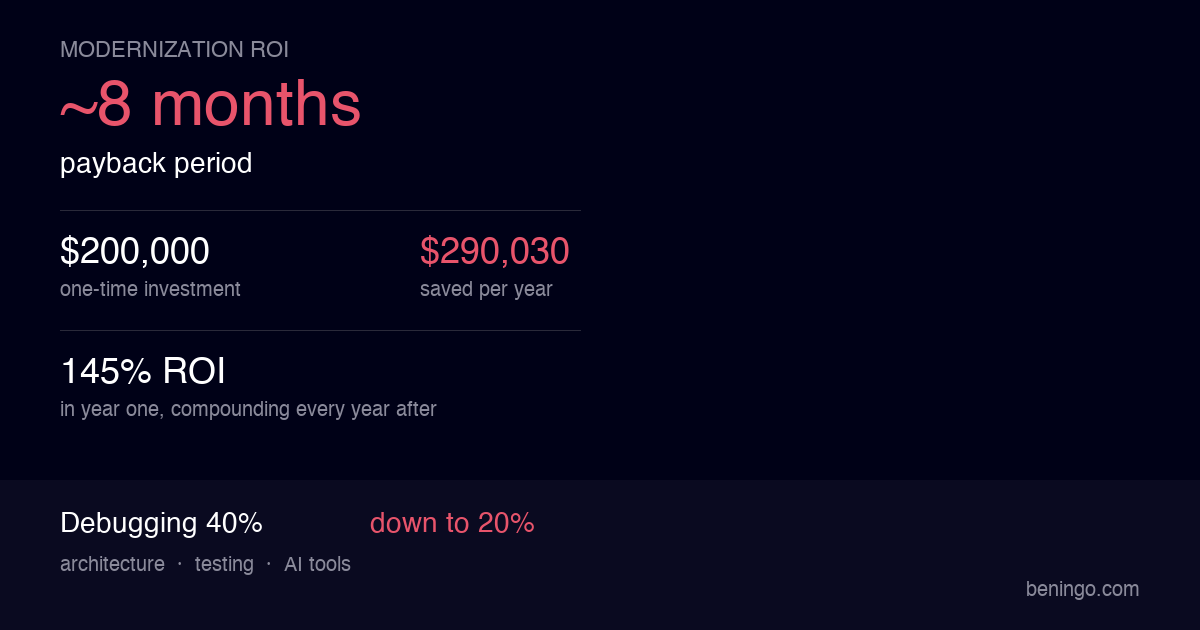
If that $200,000 investment cuts your debugging time in half, the numbers speak for themselves:
| Metric | Before | After |
|---|---|---|
| Debugging time | 40% | 20% |
| Annual debugging cost (8 engineers) | $580,061 | $290,030 |
| Annual savings | — | $290,030 |
| Investment | — | $200,000 |
| Payback period | — | ~8 months |
After that, the savings compound year over year.
More importantly, your team gets that capacity back. For an 8-person team working 2,080 hours per engineer per year, cutting debugging from 40% to 20% recovers 3,328 hours annually. That’s the equivalent of 1.6 full-time engineers worth of capacity redirected from rework to shipping features, improving quality, and reducing time to market.
The key is knowing where to start. After working with dozens of embedded teams, I’ve found the most effective approach follows a structured, seven-step modernization path where each improvement compounds the returns of the next. That framework, which I teach in my Faster. Smarter. Firmware. seminar, is:
- Metrics and continuous improvement close the loop. Tracking defect escape rates and rework time makes the debugging tax visible and gives engineering leaders the data to justify further investment and to demonstrate ROI to the business.
- AI-enabled development compresses the feedback loop even further. AI-assisted code review, test generation, and static analysis catch defects before they enter the codebase, shrinking the debugging tax at the source rather than cleaning it up downstream.
- Architecture and design patterns provide the structural foundation that makes testing possible in the first place. Modular designs with hardware abstraction layers isolate failures, reduce coupling, and prevent the cascading defects that turn a simple bug into a week-long investigation.
- Build systems and automation give your team a consistent, reproducible foundation. When every engineer builds from the same environment, an entire class of “works on my machine” bugs disappears immediately.
- CI/CD pipelines move defect detection to the commit level. Instead of discovering integration failures on hardware, your team catches regressions automatically before they compound into the expensive problems that show up during bring-up. (And this can include hardware-in-the-loop testing too!)
- Testing and simulation let engineers validate behavior on the host before touching hardware. This is the single highest-leverage investment most teams can make, and it’s where the 10x to 15x cost differential from the NIST data hits hardest in reverse, in your favor.
- Adopt professional practices by standardizing your estimation, project management, and toolchain selection. Technical improvements only stick when the operational foundation supports them.
Each step builds on the last. Teams that follow this path don’t just reduce their debugging tax; they build the organizational capability to keep it low, sprint after sprint.
Investing in a modular architecture and automated testing catches the most common preventable defects — the ones that silently inflate your embedded engineer cost every sprint.
Why This Matters for Engineering Leadership
Understanding the true embedded engineer cost isn’t just a finance exercise. It’s a strategic tool for making better decisions about where to invest in your team.
When you can quantify the cost of rework, you can build a business case for process improvements that would otherwise be dismissed as “nice to have.” For instance, it’s hard to justify a $50,000 CI/CD pipeline in the abstract. However, it’s easy to justify when you can show it eliminates $150,000 in annual debugging costs.
Similarly, understanding firmware total ownership development costs helps you see beyond the initial salary number to the full picture of what your engineering team costs and what it delivers.
The math is simple. The hard part is being honest about how much time your team spends on preventable bugs versus building the features that move your product forward.
What Could You Build With That Capacity?
Here’s the uncomfortable truth: most embedded teams aren’t slow because their engineers aren’t good. They’re slow because a significant portion of every sprint is quietly consumed by preventable rework. The talent is there. The capacity is being taxed away.
Here’s what you can do today to understand how much you’re being taxed and reduce it
- Count your embedded engineers, including contractors, and calculate your fully loaded team cost using the $181,269 baseline or your own numbers.
- Estimate honestly what percentage of engineering time goes to debugging, integration issues, regression bugs, and rework. Multiply that by your team cost. That number is your annual debugging tax.
- Audit where your defects are being caught. If the answer is hardware integration or system test, you’re paying the 10x to 15x cost premium the NIST data describes and you have a clear starting point for modernization.
Run the numbers for your team and see what falls out. Then decide whether that’s a number you can live with.
For teams willing to do the math and act on it, the payback is fast, and the compounding returns are significant. The capacity is already inside your team. The question is whether you’re going to unlock it.
If you need a starting point, I work with embedded teams to identify their biggest bottlenecks and build a modernization plan that delivers measurable results. Reach out and let’s talk about what’s slowing your team down.
Struggling to keep your development skills up to date or facing outdated processes that slow down your team, raise costs, and impact product quality?
Here are 4 ways I can help you:
- Embedded Software Academy: Enhance your skills, streamline your processes, and elevate your architecture. Join my academy for on-demand, hands-on workshops and cutting-edge development resources designed to transform your career and keep you ahead of the curve.
- Consulting Services: Get personalized, expert guidance to streamline your development processes, boost efficiency, and achieve your project goals faster. Partner with us to unlock your team's full potential and drive innovation, ensuring your projects success.
- Team Training and Development: Empower your team with the latest best practices in embedded software. Our expert-led training sessions will equip your team with the skills and knowledge to excel, innovate, and drive your projects to success.
- Customized Design Solutions: Get design and development assistance to enhance efficiency, ensure robust testing, and streamline your development pipeline, driving your projects success.
Take action today to upgrade your skills, optimize your team, and achieve success.