A Better Embedded Strategy: Flip the Stack and Develop Top-Down
Whenever you start a new embedded project, chances are the first thing you do is grab a development board. You set up a development environment, run some sample code, and start coding your project. That’s how most projects I’ve seen begin—but is it really the best way to develop embedded software?
Especially when speed, customer alignment, and reusability matter, is this bottom-up approach really helping you meet business goals?
The Problem with the Bottom-Up Approach
Embedded developers tend to think from the hardware up. Suppose I tell a team that the product’s first feature is a heater that turns on and off. I rarely get questions about how the heater works. Nobody asks about minimum and maximum thresholds, customer safety requirements, hysteresis, bang-bang control, or system-level behavior.
Instead, I’m asked:
- What GPIO pin is the heater connected to?
- How does the peripheral work?
- What drivers do we need?
That thinking makes sense, but not for where we are in the process.
At this point, the customer doesn’t care about GPIOs. Your boss doesn’t care about drivers. The business needs a working feature—something visible, testable, and demonstrably aligned with product goals. They want to see it early, test it often, and provide feedback before months of effort are sunk into details that might not matter.
The Cost of Delayed Feedback
When developers focus first on low-level code, such as setting up drivers, integrating middleware, and writing board-specific routines, they delay the application layer. It’s often months before the product team or customer sees anything meaningful.
Worse, development on a dev board typically involves slow compile-program-debug cycles, limited tooling, and non-representative hardware. Meanwhile, opportunities to validate the product direction are missed. If the application turns out to be off-target, all that low-level work is wasted.
The Case for a Top-Down Approach
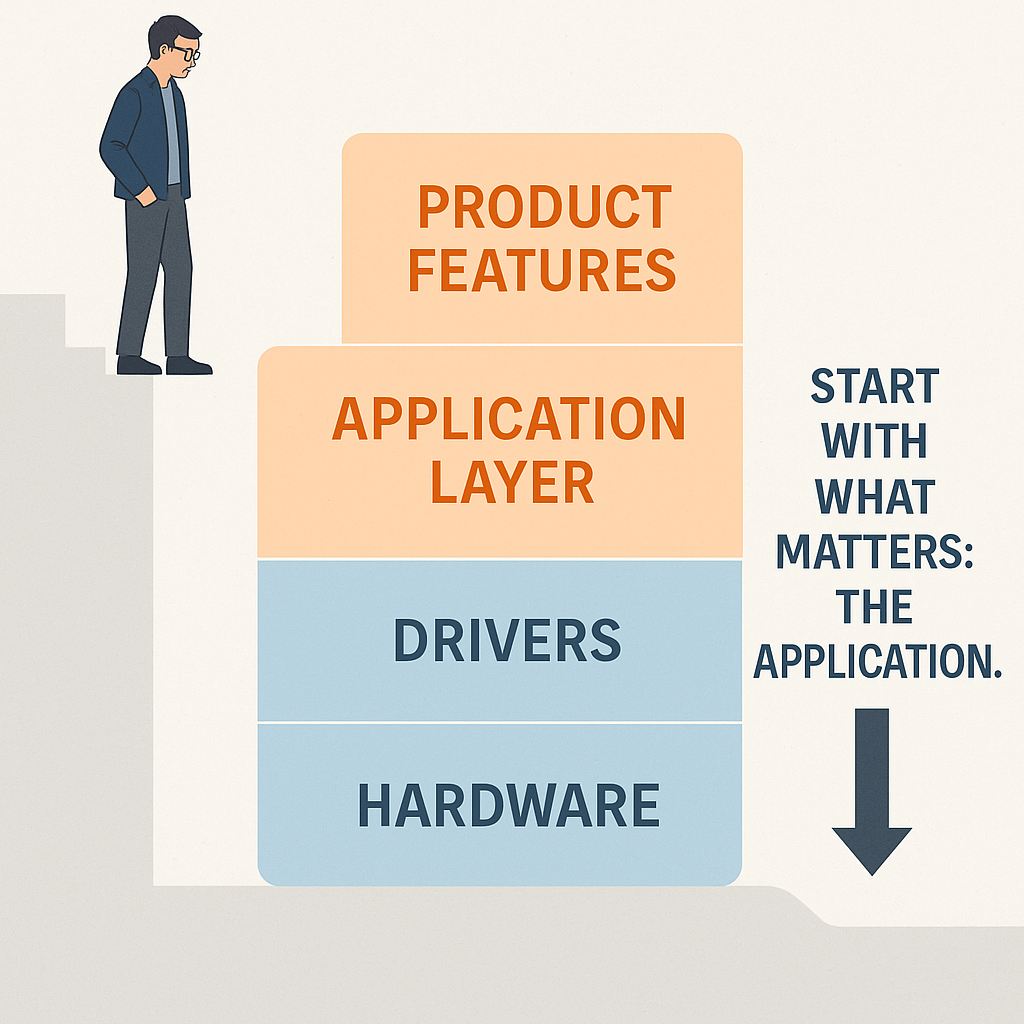
If your goal is to ship the right product on time and on budget, the fastest path is often top-down.
That means starting with your application code, the features your customer cares about, and building interfaces to the hardware that’s not there yet. You might mock the USART with a network socket. Simulate I2C responses. Replace sensor data with test fixtures.
Ridiculous? Maybe to some. But this approach creates:
- Faster validation of features and UX
- Decoupled architecture that’s easier to test, port, and reuse
- Stronger abstraction between business logic and hardware details
You still get to the low-level code eventually, but only once you know it’s worth building.
But What About Hardware-Specific Requirements?
Yes, there are valid reasons to start with a dev board:
- You need to evaluate hardware performance
- You’re designing firmware update strategies or recovery mechanisms
- You need to validate a new peripheral’s behavior
But even then, you can often isolate those needs and abstract them away from your core application logic.
Start with what the product must do. Then figure out how to support it underneath.
Change How You Think About Embedded Development
We have plenty of excuses to start from the bottom:
- “I need to understand the hardware first”
- “It’s just the way I’ve always worked”
- “We don’t have time to do it the ‘ideal’ way”
But the truth is this:
When you ditch the dev board in the early stages and focus on the application, you’ll move faster, adapt sooner, and build a more robust, testable system in the end.
It’s not a silver bullet, but it dramatically improves your odds of staying on time and on budget.
Final Thoughts
Before reaching for that dev board, pause.
Ask: What does the customer actually need?
Start with that—and build your way down.
You’ll get faster feedback, reduce waste, and create embedded systems that are more maintainable, portable, and aligned with the product’s purpose.
Top-down development isn’t just a new technique; it’s a new mindset!
Struggling to keep your development skills up to date or facing outdated processes that slow down your team, raise costs, and impact product quality?
Here are 4 ways I can help you:
- Embedded Software Academy: Enhance your skills, streamline your processes, and elevate your architecture. Join my academy for on-demand, hands-on workshops and cutting-edge development resources designed to transform your career and keep you ahead of the curve.
- Consulting Services: Get personalized, expert guidance to streamline your development processes, boost efficiency, and achieve your project goals faster. Partner with us to unlock your team's full potential and drive innovation, ensuring your projects success.
- Team Training and Development: Empower your team with the latest best practices in embedded software. Our expert-led training sessions will equip your team with the skills and knowledge to excel, innovate, and drive your projects to success.
- Customized Design Solutions: Get design and development assistance to enhance efficiency, ensure robust testing, and streamline your development pipeline, driving your projects success.
Take action today to upgrade your skills, optimize your team, and achieve success.